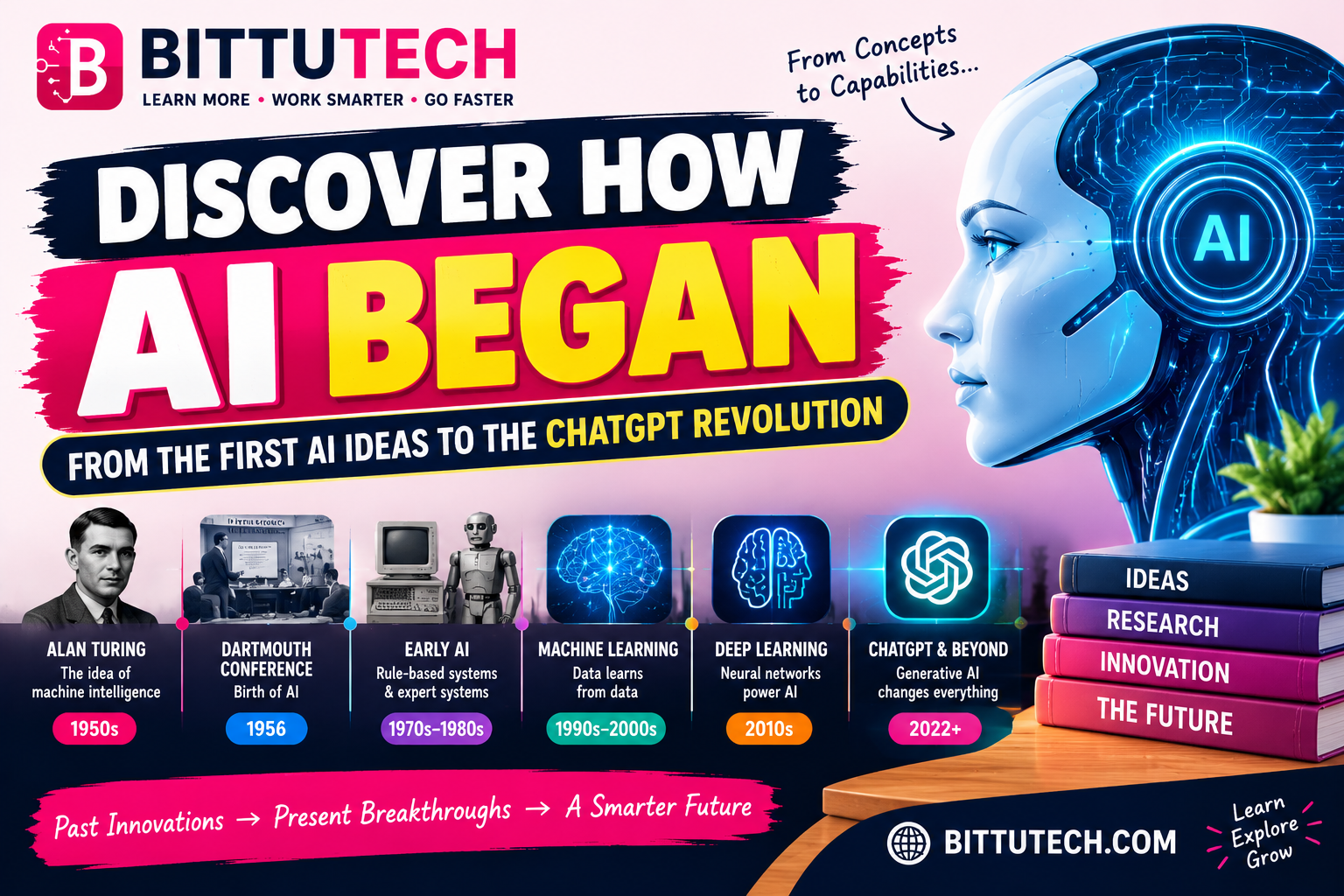
Sooo.. Welcome Again!! My lovely Tech Lovers, Yeah! I know you are here because of that Most attractive Title and you are here with full of curiosity and energy to know about What is AI?, From Where it started and so on so forth.
I know You know me😎, I’m Your all time favourite Tech Blogger, Came here with most interesting topic on my Tech site – Bittutech.com
So without wasting any time, Let’s started — Discover how artificial intelligence began at Dartmouth in 1956, how it is used today, and why we should use it with care.
Artificial intelligence, or AI, is no longer something we only see in science-fiction films. It can help answer questions, suggest a route, sort photos, translate languages, and draft text. But AI did not appear overnight. It grew from years of research into one big question: could a machine carry out tasks that usually need human intelligence?
What Is Artificial Intelligence?
Table of Contents
AI is a name for computer systems that can perform tasks such as finding patterns, responding to language, or making predictions. Some systems can also create new text, images, audio, or code.
You may already use AI without thinking about it. A video app may suggest what to watch next. A map app may recommend a route based on traffic. A chatbot may respond to a question in everyday language.
These systems do not think or feel just like people. They use data and computer methods to produce results. That means an AI answer can sound confident and still be wrong, so important information should be checked.
Why Dartmouth Is Part of AI History
In the summer of 1956, a group of scientists and mathematicians met at Dartmouth College in the United States. They wanted to explore whether parts of human learning and intelligence could be described clearly enough for a machine to copy them.
The meeting was called the Dartmouth Summer Research Project on Artificial Intelligence. John McCarthy, then a young mathematics professor, helped lead it. Dartmouth’s account describes the workshop as the place where the term “artificial intelligence” was coined, debated, and defined. The event became a landmark in the start of AI as a formal area of research.
This does not mean that modern chatbots appeared in 1956. Computers then were limited, and the ideas were still at an early stage. The workshop gave researchers a shared name and a direction for exploring machine intelligence.
From Early Ideas to Tools People Use
AI developed over many decades. Early programs worked on narrow tasks, such as solving problems or following rules. Later, computers became faster and more data became available. This helped researchers build systems that could learn patterns from examples.
Today, AI is used in many settings. It can help teachers create practice materials, help businesses draft routine messages, support doctors with certain types of data review, and help people write or create digital content. These are support tasks: people still need to check the results, especially when health, money, safety, or other important decisions are involved.
Dartmouth’s current work shows how wide these uses can be. Its researchers are exploring AI for mental health support, health-care messages, language preservation, and personalized learning. The university also highlights the need to consider ethics, safety, and trust as these tools are developed.
How Does AI Learn?
A simple example is a system that identifies cats and dogs in pictures. Researchers can give it many labelled images. During training, the system looks for patterns that often appear in each group. Later, it can examine a new picture and make a prediction.
This process can be useful, but it is not perfect. If the examples are incomplete or unfair, the system may make poor predictions. A result also depends on the task and the information available to the system.
What AI Can—and Cannot—Do
AI can save time on some repetitive tasks and help people work with large amounts of information. It can also support learning, writing, research, and creative work.
But it has limits. It may give incorrect answers, reflect unfair patterns in its data, or raise privacy concerns. AI-generated images, voices, and videos can also be used to mislead people. And while researchers continue to explore more capable systems, human-level general AI remains a goal or concept—not something we should assume has been achieved.
A practical rule is simple: use AI as a tool, not as the final authority. Check important claims, protect private information, and ask a qualified person for help with high-stakes decisions.
What Might Come Next?
AI tools may become more useful in areas such as education, health care, software development, and everyday work. They may also become better at handling more than one kind of information, such as text and images together.
The future is not guaranteed. Better tools will need careful testing and clear responsibility. Dartmouth’s stated focus on making AI useful while considering ethics and human needs is a reminder that progress is about more than building powerful systems.
The Main Idea
AI is the result of many years of research, not a single invention. Dartmouth’s 1956 workshop helped give the field its name and a lasting starting point. Today, AI can assist with a growing range of tasks, but it still makes mistakes and needs human judgment.